




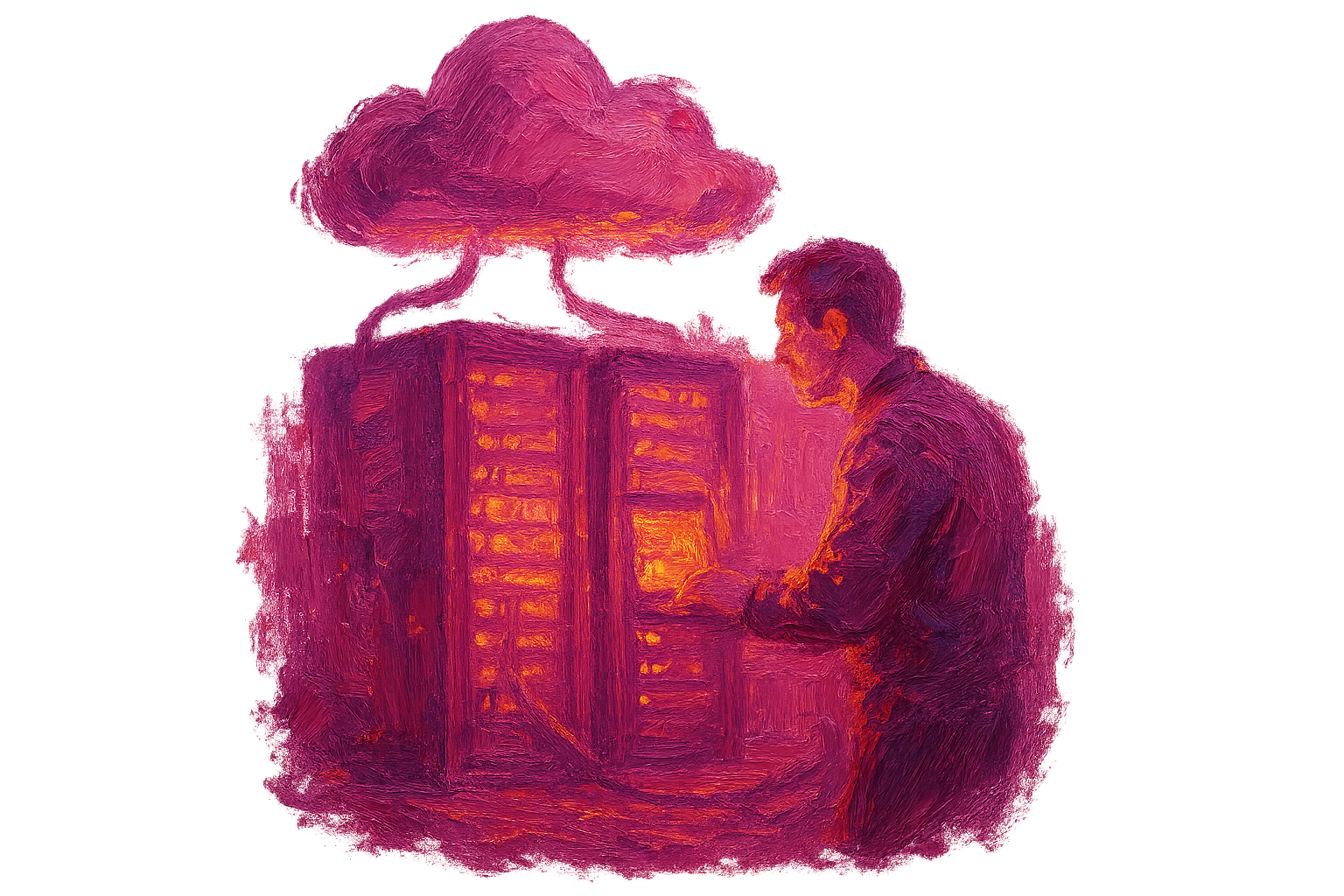


Terraform is a tool used to manage cloud infrastructure, particularly for Infrastructure as Code (IaC)...

Basic Concepts of Terraform#
Terraform is a tool used to manage cloud infrastructure, particularly standing out with the concept of Infrastructure as Code (IaC). Especially for software teams looking to build complex systems, this tool offers the ability to automatically create, update, and manage infrastructure. Terraform allows users to define infrastructure resources through configuration files and manage the lifecycle of these resources. In short, it brings together all the resources an application needs, providing more efficient infrastructure management with a code-focused approach. As Türk Bilişim, we implement such solutions and carry out various projects to provide the infrastructure management our customers need.
Quick Summary
- Terraform enables managing infrastructure as code.
- Modules and resources are the building blocks of infrastructure.
- The state file carries information about the current state of the infrastructure.
Infrastructure Modules and Resources#
In Terraform, infrastructure resources can be defined as cloud services such as servers, databases, or network components. Each resource is specified in the configuration file and can be organized within a specific module. Modules are used to group multiple resources into a single structure. For example, by grouping the server, database, and network settings required for a web application under a single module, we develop a holistic approach to these components. This way, we achieve a reusable and manageable structure.
- Using modules makes it possible to organize configurations more neatly.
- Repeated resource definitions can be simplified through modules.
State File and Management#
Terraform uses a "state" file to track the current status of infrastructure resources. This file helps Terraform determine how to manage existing resources and apply updates. The state file stores the identifiers and statuses of resources; this allows users to easily apply changes without having to recreate resources. However, managing the state file is very important because if this file is lost or corrupted, the entire management of the infrastructure could be at risk.
Planning and Application Steps#
The basic steps followed when working with Terraform play a critical role in the process of creating and managing infrastructure. First, users create a configuration file by defining the necessary resources and modules. Then, with the 'terraform plan' command, they can see how this configuration will be applied. At this stage, the Terraform plan provides the user with a detailed report on which resources will be added or updated. After the plan is approved, the changes are actually applied with the 'terraform apply' command, and the infrastructure is updated. These steps ensure the healthy management of the infrastructure.
In conclusion, Terraform provides great convenience to its users in managing complex infrastructures. With its basic concepts such as modules, state file, and planning steps, users achieve a more efficient process by managing their infrastructure as code. As Türk Bilişim, we implement such technologies and build more effective infrastructures together with our customers.
Must-Haves#
Essentials that must be present in this work:
Bonus#
Not mandatory but differentiating, optional items:
All of these elements are set up end-to-end by Türk Bilişim and deployed in a way suitable for your business.
Advantages and Disadvantages of Terraform#
Terraform is an open-source software that allows you to define infrastructure as code. This feature helps teams make infrastructure more flexible, scalable, and manageable. However, like any software, Terraform has its advantages and disadvantages. In this section, we will conduct a detailed examination of how you can benefit from the advantages Terraform provides and what potential issues you might encounter. Advantages such as automation and version control, especially in large-scale projects, can significantly improve team workflows. However, disadvantages like the learning curve and complex configuration processes should also be taken into consideration.

Advantages of Terraform#
One of the biggest advantages of Terraform is its ability to manage infrastructure as code. This ensures reliable recreation and updating of infrastructure. For example, when a team needs to create a new server, this process can be automated using infrastructure code. This minimizes manual errors and saves time. Additionally, thanks to the modular structures offered by Terraform, easy integration between different components can be achieved.
- Automation: Automates infrastructure changes, reducing human errors.
- Version Control: Simplifies tracking and rolling back infrastructure changes.
- Cloud Provider Agnosticism: Facilitates transitioning between different cloud platforms.
Easy Integration and Usage#
Terraform works compatibly with many different cloud providers and infrastructure services. This allows users to manage their infrastructure across multiple platforms using the same code. For instance, using a single Terraform file for applications running on both AWS and Azure greatly simplifies infrastructure management. Furthermore, Terraform's CLI interface enables users to quickly make infrastructure changes via the command line.
Version Control and Requirements#
Since Terraform manages infrastructure as code, it can integrate with version control systems. This makes it easier for teams to track infrastructure changes and revert to previous versions if needed. For example, saving the current version of the infrastructure before an update allows for quick fixes of potential errors. However, for this to work effectively, teams need to learn how to use version control systems efficiently.
Potential Disadvantages#
Although Terraform offers many advantages, it also has some disadvantages. Firstly, the learning curve can be quite steep for new users. Teams new to infrastructure coding may face difficulties for a certain period. Additionally, when complex configurations are made, managing and maintaining these structures can become challenging. Such situations can lead to wasted time and resources.
In conclusion, Terraform is an important tool in modern software development processes. However, it should be used by considering its advantages and disadvantages. While teams benefit from the automation and management capabilities Terraform offers, they must also pay attention to the learning processes and complexities. By maintaining this balance, they can achieve great success in infrastructure management with Terraform.
Pros and Cons#
Advantages
- Reduces human errors by automating infrastructure management.
- Integration with version control systems facilitates tracking infrastructure changes.
- Ensures consistency between different environments (development, test, production).
Points to Consider
- State file management can become difficult in large and complex infrastructures.
- Incorrect configurations can lead to undesirable results.
Infrastructure Management with Terraform#
Infrastructure management is one of the most critical elements of modern software projects. Effectively managing the required resources reduces costs in the long run and increases system reliability. Terraform emerges as a revolutionary tool in this process. By turning infrastructure into code, it enables integration with version control systems and facilitates automated deployment processes. This allows teams to manage resources faster with fewer errors. Additionally, Terraform's open-source structure and extensive community support enable users to develop customized solutions.
Core Features of Terraform#
Terraform offers many powerful features for infrastructure management. Among these, the most notable is the "infrastructure as code" (IaC) approach. This method allows infrastructure to be managed programmatically. Users can quickly scale their software according to their needs and apply changes instantly. For example, if heavy traffic is expected on a web application, resources can be rapidly increased with Terraform. Furthermore, the time required for environmental changes is significantly reduced. Additionally, thanks to its modular structure, users save time by developing reusable components.
- Modular structure: Infrastructure components are organized and managed as modules.
- Version control: Changes can be tracked, making it easy to revert errors.
- State management: Terraform records the current state of the infrastructure to manage changes.
Infrastructure Automation with Terraform#
Terraform is an excellent tool for automating infrastructure. For instance, while creating a new virtual machine on a cloud provider typically requires several steps, this process can be accomplished with just a few lines of code using Terraform. A common mistake in infrastructure automation is manually managing resources. This leads to both time loss and human errors. By using Terraform, this process is automated, allowing system administrators to focus on other tasks. For example, a user can set up and deploy a new service with just a few commands, significantly reducing deployment time.
Team Collaboration and Cooperation with Terraform#
Collaboration is crucial for infrastructure management in modern software development projects. Terraform allows teams to work on a shared infrastructure codebase. This enables changes to be tracked by every team member and reverted when necessary. For instance, different team members within a project can develop their own modules and store them in a central repository to share with other teams. This improves code quality and minimizes time loss. Additionally, integration with version control systems like Git simplifies change management.
In conclusion, Terraform is a revolutionary tool for infrastructure management. The automation, modular structure, and collaboration opportunities it provides help manage software projects more effectively. Teams can manage resources faster with fewer errors and apply changes instantly. As Türk Bilişim, we are happy to assist you with our expertise in integrating and using such tools.
Common Mistakes#
State File Management
Improper management of the state file can leave the infrastructure in an inconsistent state. This is common, especially when teams work with multiple people. The correct approach is to keep the state file in a version control system and update it regularly.
Lack of Module Usage
Not using modules leads to code duplication and maintenance difficulties. Repeated code segments increase the likelihood of errors when making changes. Adopting a modular structure facilitates code reusability and management.
Incorrect Planning
Not using the 'plan' command before making infrastructure changes with Terraform can lead to unexpected results. The planning phase allows you to preview the changes to be made. Therefore, it is critical to always use the 'plan' command.
Use Cases of Terraform#
Terraform is a powerful tool for modern cloud architecture and infrastructure management. Operating with the philosophy of managing infrastructure as code, this tool enables developers and system administrators to easily manage complex infrastructure components. Especially with the widespread adoption of cloud-based services, the automation and scalability solutions provided by Terraform offer significant advantages across many sectors. Companies in both the public and private sectors prefer Terraform to make their infrastructure more efficient and manageable. In this article, we will take a detailed look at the different use cases of Terraform and explore the benefits it provides.

Infrastructure Management and Automation#
Terraform simplifies processes such as the automatic creation, updating, and version control of infrastructure. By allowing you to define your infrastructure components with code, managing these components becomes quite straightforward. For example, when defining a server group or database clusters, you can create configurations tailored to your needs using the modules offered by Terraform. Thus, infrastructure can be created, updated, or deleted automatically without requiring manual intervention.
- You can standardize your infrastructure components with reusable modules.
- Tracking and versioning infrastructure changes with Terraform helps prevent errors.
Multi-Cloud Strategies#
Many companies need the ability to transition between different cloud providers. Terraform steps in at this point, simplifying the management of multi-cloud environments. For instance, you have the opportunity to create infrastructure using the same codebase on different cloud providers like AWS, Azure, and Google Cloud Platform. This provides flexibility for companies and frees them from being dependent on a specific cloud provider.
Enhancing Infrastructure Security#
One of the most significant advantages of Terraform is its ability to enhance infrastructure security. When infrastructure is managed as code, it becomes possible to define security policies within that code. For example, all necessary permissions and policies required for an application to run securely can be defined within Terraform files. Thus, every change made to the infrastructure can be carried out in accordance with security standards.
Supporting DevOps Processes#
DevOps culture aims to foster better collaboration between software development and operations teams. Terraform plays a crucial role in this context because automated processes accelerate software development and deployment cycles. Developers can quickly create infrastructure using Terraform and test the applications they are working on. This method shortens the software development lifecycle while also minimizing error rates.
In conclusion, the advantages provided by Terraform, such as automation, flexibility, and security, make it an indispensable tool for many companies today. With evolving technology and increasing business demands, the use cases of Terraform are expected to expand further. For companies seeking fast and reliable solutions in infrastructure management, working with expert firms like Türk Bilişim will further facilitate these processes.
The Power and Importance of Terraform
Terraform is a revolutionary tool in modern infrastructure management and accelerates software development processes.
By enhancing collaboration between developers and system administrators, it enables more efficient management of infrastructure. This allows teams to innovate faster and make their infrastructure more reliable.
Terraform vs. Other Infrastructure Tools#
Terraform is a highly popular tool for modern infrastructure management. It allows you to define infrastructure as code, automating configuration and deployment processes. However, Terraform is not a standalone solution; it has distinct advantages and disadvantages when compared to many other infrastructure tools. When used in conjunction with other tools, the flexibility and scalability offered by Terraform simplify managing complexity in large-scale projects. In this article, we will compare Terraform with other popular infrastructure tools, providing insights into which tool might be more suitable for different scenarios.
Key Advantages of Terraform#
Terraform offers users numerous advantages. Primarily, the ability to manage infrastructure with code enables version control and change tracking. This fosters better collaboration opportunities within teams. For instance, when a developer wants to make changes, the history of those changes is recorded, and reverting to previous versions is easily achievable if needed. Furthermore, Terraform's modular structure allows users to create their own modules and reuse existing ones. This makes it possible to rapidly build and update infrastructure.
- Ability to manage infrastructure with code
- Reusable components through a modular structure
- Version control and history tracking
Comparison with Other Infrastructure Tools#
When evaluating Terraform, we must compare it with other popular infrastructure tools. For example, configuration management tools like Ansible and Chef often offer more automation and configuration management. Ansible uses a simple configuration language, enabling users to write complex configurations more easily. On the other hand, Chef uses the Ruby language to define infrastructure, providing more flexibility for developers. However, these tools generally may require a steeper learning curve.
Integrated Use of Terraform with Other Tools#
The integration of Terraform with other infrastructure tools plays a critical role in managing project complexity. For instance, when Terraform is used together with Ansible, Terraform can build the infrastructure while Ansible handles application configuration and management. This integration creates stronger alignment between the infrastructure and application layers for teams. Additionally, in CI/CD (Continuous Integration/Continuous Deployment) processes, the integration of these two tools significantly accelerates the deployment pipeline.
Common Mistakes and Best Practices#
There are common mistakes made when using Terraform and other infrastructure tools. For example, relying solely on Terraform to code infrastructure can lead to integration gaps with other tools. Users may encounter issues when they try to integrate the infrastructure they built with Terraform into other tools without sufficient forethought. To avoid these mistakes, you should understand the strengths and weaknesses of each tool and create the most suitable combination for your project. Furthermore, it is crucial to always follow best practices and keep documentation regularly updated.
In conclusion, Terraform is a powerful infrastructure tool that becomes even more effective when used in conjunction with other tools. To succeed in your projects, you must carefully analyze your needs and resources and select the right tools. Remember, you can contact the expert team at Türk Bilişim to find the most suitable solution for your projects and receive support at every stage.
Contact Turkish Informatics#
Get a free discovery and quote from Turkish Informatics' expert team for your project; let's achieve your digital goals together:
- Phone: 0216 755 3 555
- WhatsApp: 0532 216 07 54
- Email: [email protected]
- Web: turkbilisim.com.tr

Bu içeriği nasıl buldunuz?
Reaksiyon vermek için giriş yapmanız gerekiyor.
You Might Also Like






Gallery